Aging Population & Memory Care Investment Timing
Senior Housing, Memory Care, Real Estate Investment
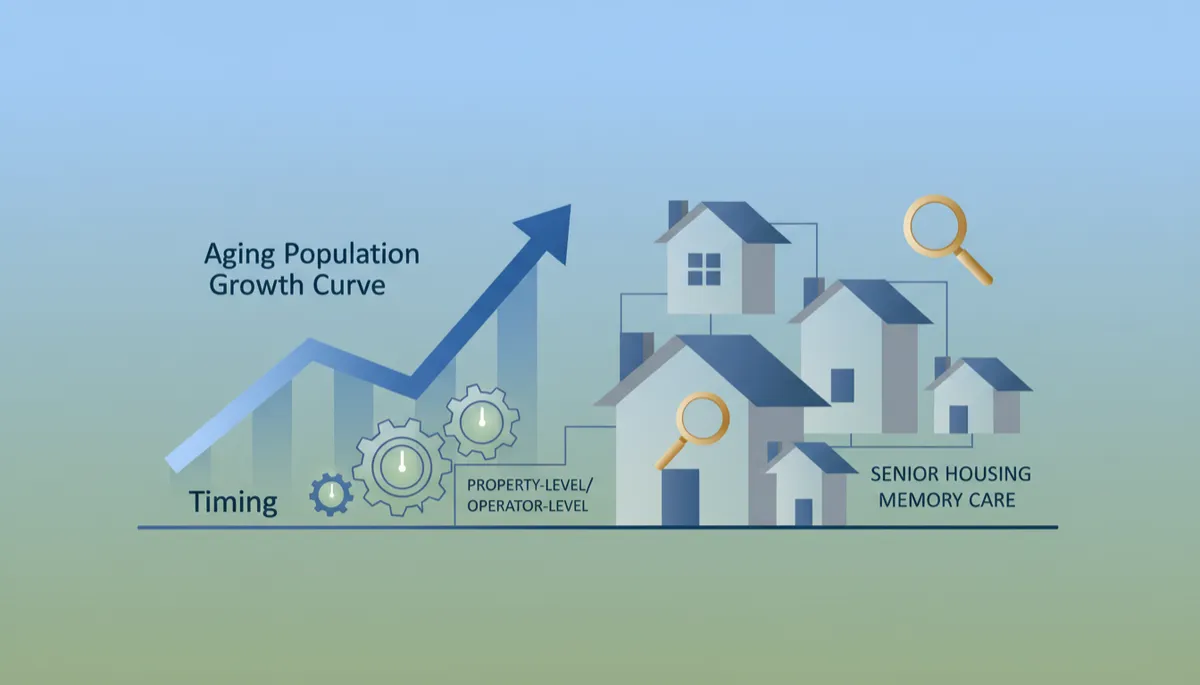
What the Aging Population Growth Curve Means for Memory Care Demand Timing
The world is aging faster than ever, and memory care demand is already accelerating. For investors, the question is no longer if there will be opportunity in senior housing, but when and where to deploy capital—and with whom. Understanding the aging population growth curve, evolving supply trends, and the nuances of due diligence is critical to getting the timing right.
1. The Demographic Shift: A Long, Powerful Demand Wave
Demographics are the foundation of the memory care story. Globally, adults aged 65 and older represented about 10.5% of the population in 2025 and are projected to reach nearly 19.6% by 2060, according to the U.S. Census Bureau. The number of people aged 60+ is expected to more than double from 1 billion in 2020 to 2.1 billion by 2050.
In the United States, the median age reached 39.4 years in 2025, up from 35.6 in 2001. There were 57.8 million Americans 65+ in 2022—17.3% of the population—with projections pointing to 88.8 million by 2060. At the same time, the population aged 45–64 actually shrank by 2.68 million between 2020 and 2025, tightening the pool of family caregivers and workers just as older-adult needs rise.
For memory care specifically, these demographic shifts are amplified by disease prevalence. The Alzheimer’s Association estimates 7.4 million Americans 65+ are living with Alzheimer’s in 2026, up from 6.5 million only three years earlier, and nearing 8.5 million by 2030. Crucially, the first Baby Boomers turned 80 in 2026, marking the start of a multi-decade surge in the 80+ population—growing at roughly 4.1% annually through 2040. This is the age band most likely to need high-acuity support, including memory care.
📌 Key Takeaway: The aging curve is steep and sustained. For memory care, demand is not a short-term spike but a multi-decade structural trend.
2. Supply Trends: Tight Inventory, Rising Occupancy
While the aging population curve points sharply upward, new memory care supply has lagged. Across 99 NIC MAP primary and secondary markets, memory care occupancy reached 88.4% in Q1 2026—up 2.1 percentage points year-over-year and roughly 6 points higher than in early 2019. Over that same period, occupied units grew about 30%, while inventory expanded only 22%. In the last year alone, inventory increased a modest 0.5%, compared with a 2.9% rise in occupied units.
The broader senior living picture tells a similar story. Overall senior housing occupancy hit 90% in Q4 2025, the highest since 2017, with net absorption outpacing new supply by nearly 5 to 1. Only about 2.3% of inventory was under construction, and assisted living supply growth hovered at just 0.7% year-over-year—its lowest level since 2006. Within CCRCs, memory care has led all segments in absorption and is the only one showing meaningful inventory growth.

Demand growth outpacing new construction is tightening memory care fundamentals in many U.S. markets.
This imbalance supports pricing power. Average U.S. memory care costs reached about $6,690 per month in 2025, up 3.7% year-over-year, according to A Place for Mom. For investors, constrained supply plus rising needs-based demand creates a compelling, if complex, backdrop.
3. Timing an Investment in Senior Housing and Memory Care
With demographics and supply both working in favor of memory care, the next question is timing. From a macro perspective, senior housing is early in a long up-cycle. The Baby Boomer cohort is only beginning to enter the highest-need years, and CBO projections show the 65+ population growing faster than the working-age population for at least the next decade before gradually slowing.
That said, senior housing remains a highly local business. Some metros still carry legacy oversupply from pre-pandemic building booms, while others—especially secondary and tertiary markets with aging populations and shrinking middle-aged cohorts—are severely undersupplied. Interest rates, construction costs, and lending conditions also influence whether it is better to acquire existing assets, reposition underperforming properties, or pursue ground-up development.
💡 Pro Tip: Think in terms of market-by-market timing, not just “now or later.” Align your entry point with local occupancy, pipeline data, and demographic depth.
For many investors, the most attractive near-term opportunities lie in:
Acquiring well-located but operationally underperforming communities and partnering with stronger operators.
Targeting markets where 75+ and 80+ populations are growing rapidly but construction pipelines remain thin.
Positioning ahead of the next demand “step-up” as more Boomers cross into their late 70s and 80s over the next 5–10 years.
4. Property-Level Due Diligence: The Ground Truth
Even with favorable macro trends, performance is determined asset by asset. Thorough property-level due diligence is essential before committing capital to any senior housing or memory care investment. Key areas to scrutinize include:
Location and trade area: Analyze the 5–10 mile radius for current and projected 75+/80+ households, income levels, and competing communities. A strong national story cannot fix a weak local market.
Physical plant and design: Evaluate building age, layout, safety features, and whether the environment truly supports dementia care best practices—secure outdoor spaces, clear wayfinding, small-group living areas, and sensory-friendly finishes.
Capex needs and regulatory risk: Identify deferred maintenance, upcoming capital expenditures, life-safety compliance issues, and any survey or licensing deficiencies that could affect operations or valuations.
Historical performance: Review occupancy, rate growth, length of stay, and expense trends through multiple cycles to understand whether underperformance is fixable or structural.
⚠️ Warning: A full building in a shallow market, or one facing major capital needs, can quickly become a drag—even when national demand is strong.
5. Operator-Level Due Diligence: The Critical Partner Decision
In senior housing—and especially in memory care—the operator is as important as the real estate. The sector’s resilience during past economic downturns has been strongest where experienced, well-capitalized operators were in place. As you consider timing an investment, build equal rigor into operator-level due diligence:
Track record and specialization: Look for operators with proven expertise in memory care, not just general senior living. Ask for performance benchmarks across their portfolio and through different cycles.
Clinical and staffing model: Evaluate staffing ratios, training programs, turnover rates, and how they manage rising labor costs—especially important as the middle-aged workforce shrinks and caregiver shortages intensify.
Sales, marketing, and pricing strategy: Understand how the operator positions rates, manages move-ins, and responds to changing competitive conditions while maintaining occupancy and margin discipline.
Technology and innovation: Leading operators are integrating technology for fall detection, electronic care records, family communication, and predictive staffing—enhancing both resident outcomes and operational efficiency.
The right operator can turn a good demographic story into durable cash flows. The wrong one can squander even the best-located asset in a high-demand market.
Bringing It Together: Demographics, Timing, and Discipline
The aging population growth curve is clear: more older adults, more cognitive impairment, and more years lived with care needs. Memory care demand is already outpacing supply in many markets, and structural demographic forces suggest this will continue for years to come. That makes senior housing—and memory care in particular—an attractive long-term investment theme.
But opportunity does not erase risk. The most successful investors will pair a strong top-down thesis with disciplined bottom-up execution: reading the demographic curve, tracking local supply trends, timing entry by market, and insisting on rigorous property-level and operator-level due diligence. In a sector where care, people, and place intersect, that combination is what turns demographic inevitability into sustainable returns.


