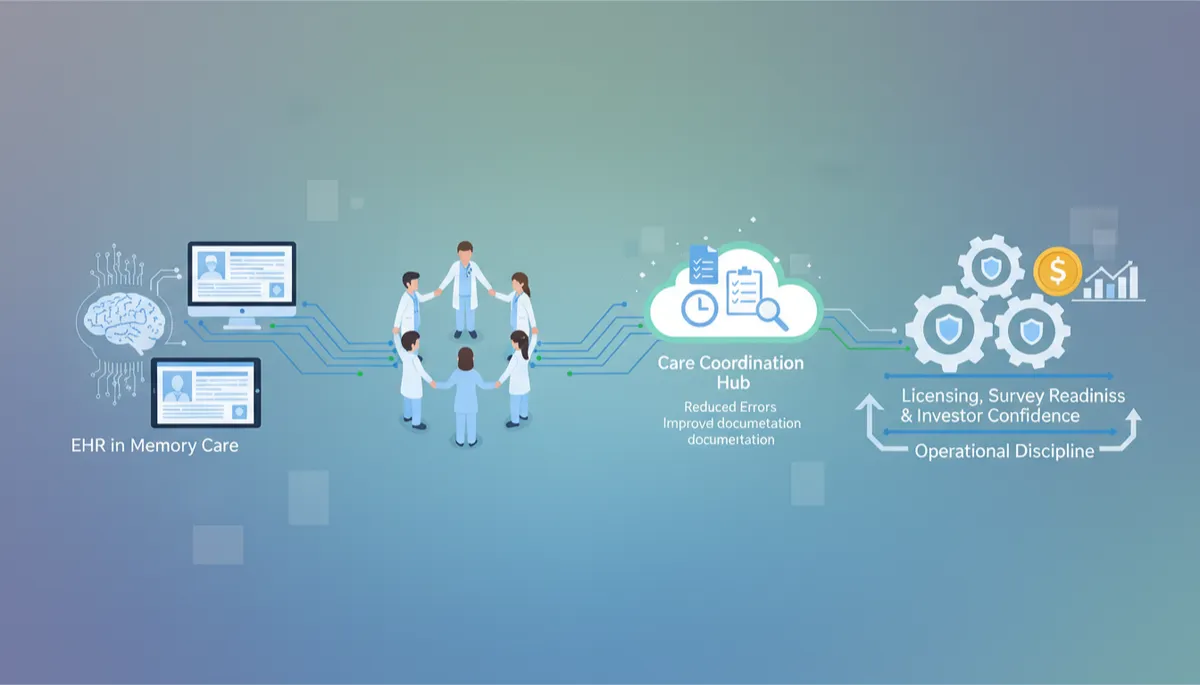
Boost Memory Care with EHR & Coordination Tech
Memory Care, EHR, Care Coordination, Senior Living Operations
How EHR and Care Coordination Technology Boost a Memory Care Community’s Efficiency
Electronic Health Records and care coordination software are no longer “nice to have” tools in memory care communities. They are core infrastructure that shape resident safety, survey performance, and even how attractive an operator looks to investors.
What EHR Really Means in a Memory Care Setting
In a memory care community, an Electronic Health Record (EHR) is far more than an electronic chart. It is the central hub for a resident’s clinical and personal story: diagnoses, medications, allergies, behavioral patterns, fall risk, family contacts, and care plans tailored to cognitive decline. Because residents often cannot reliably communicate needs, staff rely heavily on what the EHR tells them about each person’s baseline and triggers.
A strong memory care EHR supports:
Behavior tracking to spot changes that might signal infection, pain, or medication issues rather than “just dementia.”
Care plans that translate clinical assessments into concrete daily tasks for caregivers on each shift.
Medication management with clear orders, schedules, and alerts to reduce the risk of missed or duplicated doses.
When these elements live in a well-configured EHR, staff can move quickly and consistently, even when turnover or agency staffing disrupts continuity of care.
How Care Coordination Software Reduces Missed Documentation and Errors
Care coordination platforms turn what is in the EHR into actionable workflows. Instead of relying on paper task sheets, sticky notes, or memory, caregivers see real-time task lists tied directly to each resident’s care plan: medication passes, toileting schedules, skin checks, nutrition support, and behavior monitoring. As tasks are completed, staff document at the point of care with a tap or short note.
Fewer missed tasks: Automated reminders and visual dashboards highlight overdue or high-priority items so nothing quietly falls through the cracks on a busy shift.
Cleaner documentation: Standardized forms, drop-down options, and templates reduce free-text variation and make it harder to skip required fields.
Faster error detection: Supervisors can see patterns in missed care, late med passes, or incomplete notes and intervene before issues escalate.
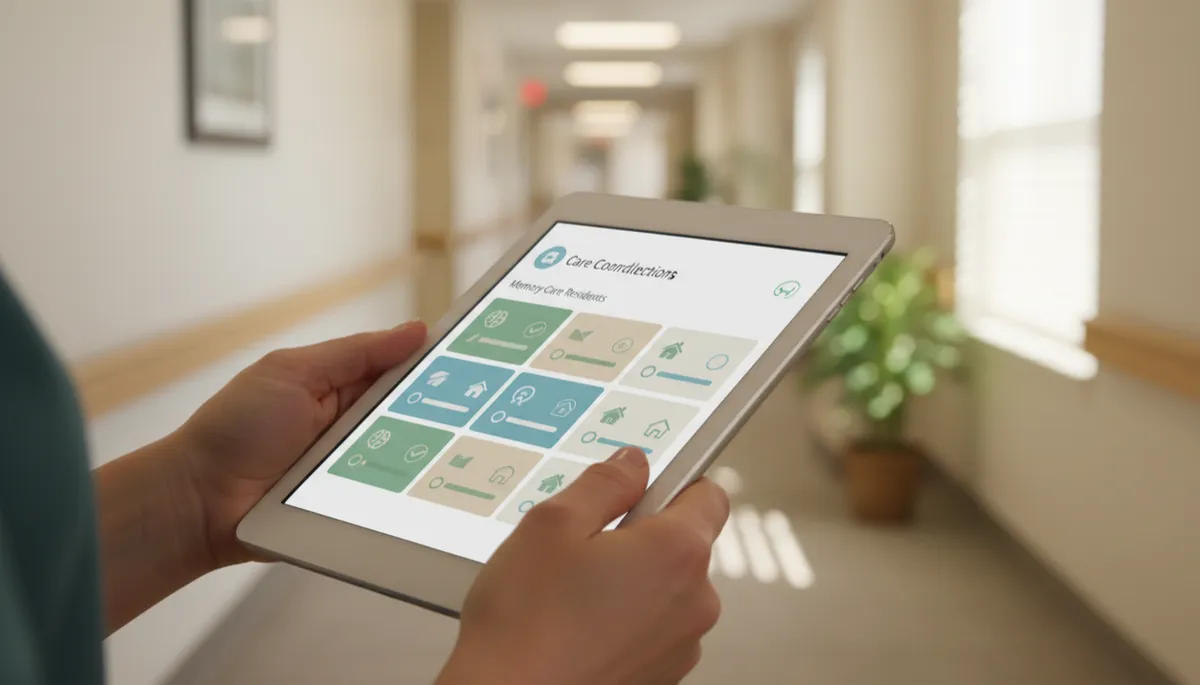
Real-time task lists and prompts sharply reduce missed care and incomplete notes.
Why Documentation and Technology Matter for Licensing and Survey Readiness
Regulators and surveyors do not just ask, “Are residents safe?” They ask, “Can you prove residents are safe and care is delivered as ordered?” In memory care, where residents may not be able to self-advocate, documentation is the evidence of care. Survey teams look for complete assessments, up-to-date care plans, consistent implementation, and timely follow-up on incidents and changes in condition.
EHR and care coordination systems that are well used make survey readiness an everyday state, not a frantic event. Administrators can pull reports on falls, psychotropic medication use, hospital transfers, and care-plan compliance in minutes. When a surveyor asks, “Show me how you monitor weight loss” or “How do you track behaviors?” the operator can navigate directly to clear, time-stamped records instead of sifting through paper binders or inconsistent spreadsheets.
💡 Pro Tip: Build mock survey drills into routine operations, using your EHR and care coordination tools exactly as you would during an actual inspection.
What These Systems Signal to Investors Evaluating an Operator
For investors, technology choices in a memory care community are a window into operational maturity. A modern EHR and care coordination stack, implemented thoughtfully, suggests an operator that understands risk, staffing pressure, and regulatory complexity. It signals the ability to scale processes across multiple communities, not just rely on a few strong local leaders.
Investors increasingly ask:
Which EHR and care coordination platforms are in use, and how deeply are they adopted at the bedside?
Can leadership produce clean, comparable metrics across the portfolio on falls, rehospitalizations, staffing, and survey outcomes?
How quickly can the operator identify and correct underperformance in a single building before it becomes a reputational or regulatory issue?
Robust systems, backed by data-driven oversight, reduce volatility in outcomes. That stability is attractive to capital partners looking for predictable performance and lower downside risk in a highly scrutinized sector.
The Power of Integrated Systems and Operational Discipline
Technology alone does not create efficiency. The real value emerges when EHR, care coordination, pharmacy, staffing, and incident reporting systems are integrated and supported by consistent processes. An integrated ecosystem reduces duplicate data entry, aligns everyone around the same source of truth, and allows leadership to connect staffing patterns with resident acuity, outcomes, and financial results.
Operational discipline means standardizing how each community uses these tools: common workflows, training expectations, audits, and accountability for documentation quality. In memory care, where resident needs are complex and unpredictable, this discipline is what turns technology from a checklist item into a competitive advantage. It supports safer care, smoother surveys, more confident families, and stronger investor confidence in the operator’s ability to grow responsibly.
Ultimately, EHR and care coordination technology are not just about going paperless. They are about building a culture where every interaction with a resident is informed, intentional, and reliably captured—protecting the people who live in the community, the teams who care for them, and the stakeholders who invest in their future.


