Property Inspections & CapEx Insights for Investors
Real Estate Investing, Due Diligence
What Property Inspections and Capex History Reveal Before You Invest
A property can boast strong rent collections and a clean profit-and-loss statement while quietly hiding six figures of near-term repairs. To see the real risk profile, investors must look beyond the spreadsheet and into the building itself through a property condition assessment and a careful review of capital expenditure history.
What a Property Condition Assessment (PCA) Actually Checks
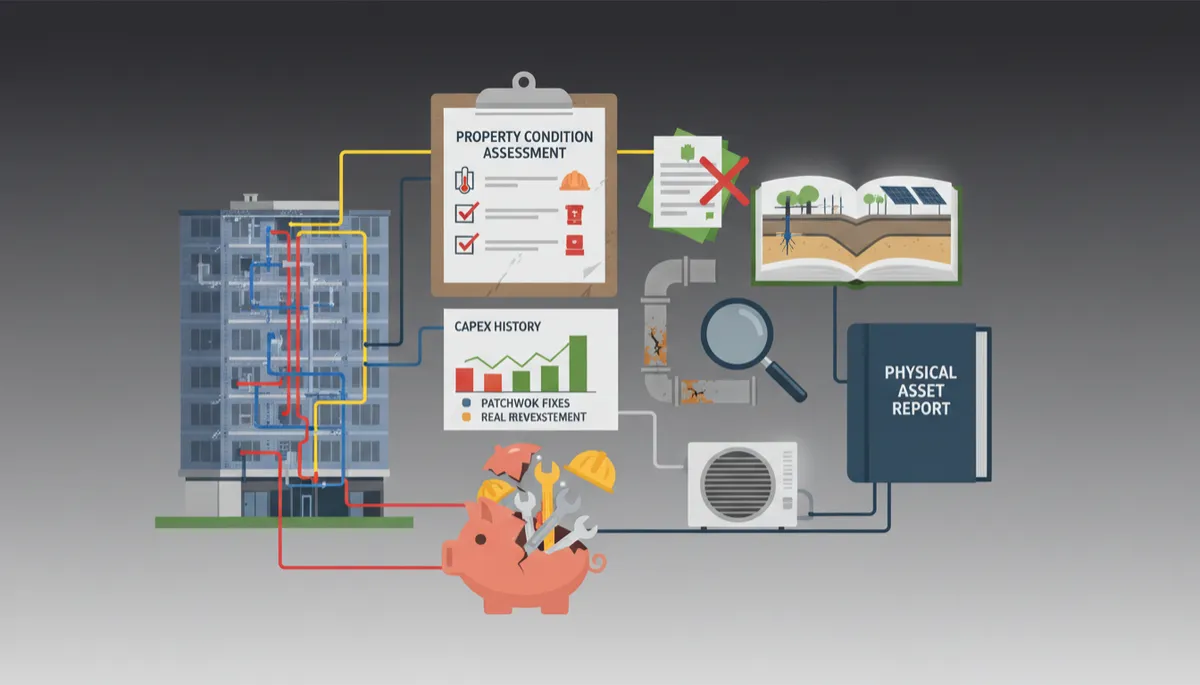
A Property Condition Assessment (PCA) is the physical counterpart to your financial due diligence. Performed by an engineer or experienced inspector, it systematically evaluates the building’s major components, estimates remaining useful life, and identifies immediate and near-term capital needs. A thorough PCA typically covers:
Site and structure: grading and drainage, parking lots, sidewalks, foundations, structural framing, retaining walls, and signs of movement or water intrusion.
Building envelope: roofs, gutters, exterior walls, windows, doors, sealants, and insulation—anything that keeps water and air where they belong.
Mechanical, electrical, and plumbing (MEP): boilers, furnaces, chillers, package units, electrical panels, distribution, domestic water lines, sewer lines, and fixtures.
Life-safety and code issues: fire alarms, sprinklers, emergency lighting, exit signage, handrails, accessibility elements, and any apparent code deficiencies or unsafe conditions.
Interior and common areas: lobbies, corridors, unit interiors (as accessible), flooring, ceilings, finishes, and evidence of leaks, mold, or chronic moisture.
The output is usually a narrative report with photos and a capital needs table summarizing immediate repairs (often within 0–12 months) and projected replacements over a 5–10 year horizon. This becomes your roadmap for budgeting real-world costs that never show up in a broker’s pro forma.
Why Deferred Maintenance on HVAC and Life-Safety Systems Is So Costly
Not all deferred maintenance is created equal. A worn carpet or dated paint may be inconvenient, but it is rarely deal-breaking. By contrast, HVAC and life-safety systems are both capital-intensive and non-negotiable. Inheriting problems here can quickly erase years of projected cash flow.
HVAC systems: Aging boilers, chillers, or rooftop units often limp along under “band-aid” repairs. When they finally fail, you are forced into emergency replacements at premium pricing, potentially for multiple units at once. On multifamily or office assets, a widespread HVAC failure can also trigger rent concessions, vacancy, or legal disputes if comfort standards are not met.
Life-safety systems: Fire alarms, sprinklers, smoke detectors, emergency lighting, and egress components must meet local codes and pass inspections. If the PCA reveals non-functioning equipment, outdated panels, or missing coverage, you may face immediate mandates from the fire marshal after closing. These are high-dollar fixes you cannot defer without risking fines, shutdowns, or serious liability exposure.
📌 Key Takeaway: Deferred maintenance on HVAC and life-safety is expensive, urgent, and often invisible in current operating expenses—making it the most dangerous category to inherit.
A good PCA will call out equipment age, condition, and code compliance, giving you a realistic sense of whether you are buying years of remaining life—or a ticking time bomb that demands a six-figure capital infusion soon after closing.
How to Read a Seller’s Capex History for Real Patterns
The capital expenditure (capex) history tells the story of how an owner has treated the asset over time. You are looking less at individual line items and more at patterns: is this an owner who reinvests strategically, or one who patches problems only when something breaks?

Consistent, planned capex usually signals stewardship; sporadic patches hint at looming surprises.
Look for chronic patchwork fixes: Repeated small invoices for the same system—monthly HVAC repairs, frequent leak “patches,” recurring plumbing calls—suggest that components are at the end of their life. The expense history may look modest, but it often precedes a major failure the next owner will have to fund.
Identify true reinvestment: Larger, clearly defined projects—roof replacement, full boiler upgrade, complete parking lot resurfacing, window replacements—indicate ownership has tackled big-ticket items proactively. When aligned with the PCA’s estimated useful life, these projects can materially reduce your near-term capital risk.
Match capex to property age and size: A 30-year-old, 100-unit property showing minimal capex over the last decade is a red flag. Even well-built assets need periodic investment. If the history looks too light, assume you are stepping into a backlog that your PCA may only partially quantify.
💡 Pro Tip: Lay the capex history next to the PCA’s capital needs table. Where you see big upcoming items with no past investment, assume you are the one who will pay for the reset.
A Clean P&L Can Hide Six Figures of Near-Term Capex
Brokers often highlight a tidy P&L: stable occupancy, controlled expenses, and attractive net operating income. But operating statements rarely include adequate reserves for major replacements. An owner who under-invests in the physical plant can keep expenses artificially low, making the property look more profitable than it truly is on a sustainable basis.
This is why the PCA and capex history deserve the same scrutiny as the rent roll and income statement. Together, they answer critical questions:
Is current NOI inflated because the owner has postponed inevitable capital projects?
Are you underwriting realistic reserves for roofs, HVAC, paving, and life-safety upgrades, or simply copying the seller’s historically low spend?
Will the first two to three years of ownership require a capital injection that materially changes your returns or leverage?
When you layer the PCA’s capital needs with the story told by the capex history, you can adjust your offer price, structure reserves with your lender, or negotiate seller credits. More importantly, you avoid the trap of buying a “great deal” on paper that, in reality, sits on top of a property hungry for six figures of near-term capital.
Final Thought: Underwrite the Building, Not Just the Numbers
Successful real estate investors underwrite two things in parallel: the income stream and the physical asset that produces it. A detailed property condition assessment and an honest reading of the seller’s capex history transform your view from “What does this property earn today?” to “What will it really cost to own over the next decade?” That shift can be the difference between a stable, cash-flowing investment and an expensive lesson in deferred maintenance.


